AUSTRALIAN IRON ORE EXPORTS
Set to Fall, Perhaps Significantly?
Australia’s iron-ore exports has risen from almost nothing in the early 1960s to over 900 million tonnes last year – around half of world exports.
Many expect a slow-down in Australian iron-ore exports.
If there is a slow-down, will it be gentle, with exports falling only gently?
Or will it be precipitous, with China’s role in the world economy falling significantly, as Japan’s did in the 1990s?
At its height in the mid-1990s, Japan’s gross domestic product (GDP) formed around 18% of global GDP.
This share stands at 4% today.
China’s GDP currently forms around 18% of global GDP.
Is it possible that this share could plummet, as Japan’s did? And with iron-exports being seriously affected?
Pessimistic views on China’s economic outlook
Some analysts outside China are pessimistic about the outlook for the Chinese economy. Here are examples
| QUOTE | SOURCE |
| “There is no question that China’s rise is at least stalling … the working and total population are now in relentless decline … productivity growth has stalled … although consumption has been made a top priority, actual policy measures to make it so have been underwhelming … China has islands of technological excellence and leadership in a sea of macro-economic turbulence and trouble … this characterised Peak Japan 40 years ago and China is shaping up for the encore”. |
George Magnus, Why Peak China may finally have arrived, August 2025. Mr Magnus is Research Associate at Oxford University’s China Centre and Soas University, London; he is the former Chief Economist at UBS Investment Bank, 1997-2016. |
| “China has exhausted its ability to draw on external demand to make up for its internal weakness”. | Brad W. Setser, China’s massive surplus is everywhere, November 2025. Dr Setser is Senior Fellow, Council of Foreign Relations, Washington. |
| As a proportion of the global economy, China's economy probably peaked in 2021 ... the primary drivers of the investment growth during the past two decades have been property construction and infrastructure development ... both have now declined sharply ... nothing else has replaced these sectors as meaningful drivers of growth, nor is there any likely to do so given the constraints of China's financial system ... the most significant threat to China would be a repeat of Japan's persistent deflationary pressure (following the mid-1990s). |
Logan Wright, China's economy has peaked: can Beijing redefine its goals?, September 2024.
Dr Wright is a partner at Rhodium Group, Washington, where he leads the firm's China Markets Research work. |
| “Because Chinese growth is so heavily dependent on investment … China has been a huge buyer of industrial commodities … eventually, when this model ends, we should see demand for industrial commodities drop very sharply and that will affect the Australian economy”. | Professor Michael Pettis, Professor of Finance, Guanghua School of Finance, Peking University, Beijing, as quoted by Matthew Cranston, The Australian, 11 November 2025. |
| In China, “Bloomberg analysis shows deflation on the ground feels more pronounced than official data show, with prices of everyday good plunging” | Bloomberg News, 10 November 2025. |
| “If prices are down for three years and inflation doesn’t come back, then people will believe it won’t come back … and that’s when China becomes Japan.” | Professor Zhu Tian, China Europe International Business School (CEIBS), Shanghai, as quoted by Bloomberg News, 10 November 2025). |
Views in Australia
The iron-ore price currently stands at a little over US$100 per tonne. It has been around this level or above it for the last three years.
However, there is a widespread view among analysts in Australia that the price will fall significantly over the next couple of years.
The Federal government forecasts a 40% drop, to US$60 per tonne, by late 2026 (see Mid-Year Economic and Fiscal Outlook, 2025-26, page 36, footnote h).
The Western Australian government forecasts a 30% drop, to a price of “US$71 a tonne from 2025-26”. It describes this price as iron-ore’s “long-term average” (see Western Australia Iron Ore Profile, May 2025, page 2).
The major banks also see a price drop. For example, as reported by the Australian Financial Review (17 December 2025), “Westpac has warned that the iron ore price will plunge 20 per cent next year to about $US83 a tonne as China slashes its steel output and a wave of fresh supply hits the market, intensifying a build-up of inventory at Chinese ports”.
The major iron-ore companies (e.g. Rio Tinto, BHP, Fortescue, Hancock Prospecting) do not appear to be this pessimistic, but do appear to accept that the iron-ore price has peaked.
Forecast price drops are based on a forecast fall in Chinese growth and, in the view of some, competition from the new Simandou mines in Guinea in west Africa, forecast to produce 120 million tonnes of iron ore by 2030. Given that Australia and Brazil are likely to produce over 1.3 million tonnes of iron ore by 2030, we think that the effect of Simandou on prices will be relatively small.
Interestingly, pessimism about the outlook for the Chinese economy does not appear to be shared by the Office of the Chief Economist in Canberra. This Federal-government agency says that “China appears likely to reach target growth rates as exports stabilise and the government takes actions to support growth; the Chinese government has lifted infrastructure spending and acted to boost investment by providing funding to Chinese policy banks” (Resources and Energy Quarterly, December 2025, page 4).
In contrast to other government agencies, it forecasts only a modest fall in iron-ore prices over the next few years.
Will China follow Japan
It seems inconceivable that China’s share of the global economy could plunge as Japan’s did as from the mid-1990s.
However, a major contraction in this share – even if not as serious as Japan’s – cannot be ruled out.
As stated by Professor Zhu Tian and reported above, “if prices are down for three years and inflation doesn’t come back, then people will believe it won’t come back … and that’s when China becomes Japan.”
And if this happened, it would change the place of China in the world dramatically – and be a serious blow for Australian iron-ore exports.
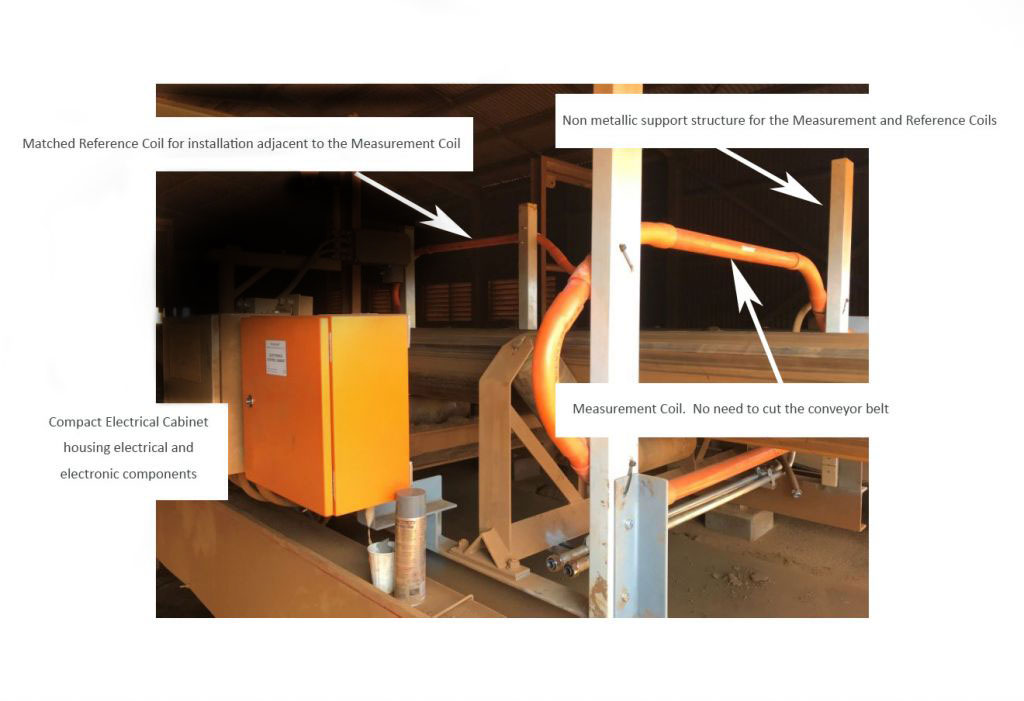
ironSCAN On Conveyor Magnetite Monitor
IRONSCAN ON CONVEYOR MAGNETITE MONITOR
The system has been designed for installation on tonnage rated conveyor belts for the measurement of the metaliferrous content of crushed ore prior to processing.
Find out more about the system here.
Talk To One of Our Specialists
We are striving to be the leading supplier of on-line process measurement technologies and are keen to offer you: