exploring the complex world of rare earths
BACKGROUND
Rare earths comprise a group of 17 elements with common characteristics; they are not in fact rare, but are not commonly found in concentrated form. Mining and processing are dominated by China.
“Applications of the rare-earth elements have grown dramatically over the past four decades … as substitutes are inferior or unknown, the rare-earth elements have acquired a level of technological significance much greater than expected from their relative obscurity” (United States Geological Service).
Processing rare-earth ores is complex. There are several rare-earth ores (e.g. monazite), each typically containing several rare-earth elements (e.g. the most common form of monazite contains lanthanum, cerium and neodymium). These elements are typically in the form of oxides. The ore is initially concentrated, to increase its rare-earth content. The different rare-earth oxides are then separated from each other. Finally, the different oxides are reduced to their metallic form (e.g. neodymium, dysprosium).
Processing steps include grinding; gravity, magnetic and/or electrostatic separation; flotation; roasting; leaching; ion exchange; solvent extraction; and calcio-thermic and/or electrolytic reduction. The resulting rare-earth metals are then alloyed with each other for specific applications (e.g. permanent magnets).
More than 40% of rare earths are used in permanent magnets (that is, magnets that retain their magnetic field indefinitely). Rare-earth magnets are the strongest type of permanent magnet, with two types.
The first is based on neodymium, sometimes including praseodymium and, where resistance to high temperatures is required, dysprosium and/or terbium. Neodymium-based magnets are the main form of rare-earth magnets.
The second is based on samarium, with samarium-cobalt magnets able to sustain very high temperatures (550 degrees plus). Uses include in jet engines, missile systems such as Israel’s Iron Dome, the bunker-buster bombs used by the US against Iran in June, and Virginia submarines, the latter to be purchased by Australia under the AUKUS partnership.
“Neodymium and samarium … have a disproportionate influence on all high-technology businesses, especially the defence industry” (Lt Colonel Justin Davey, US Air Force, writing over 10 years ago).
Rare earths are widely used (in the form of magnets and in other ways) for products including automobiles, robotics, electronics, medical equipment, loud speakers, hard-disc drives, refrigerators, jewellery, pumps and wind turbines. Smart phones each contain around eight rare earths.
Chinese dominance of rare earths is becoming of increasing concern to other countries, with the US government pushing for a substantial domestic increase in the mining and processing of rare earths. The US currently has one producer: Mountain Pass in California.
In June 2025, the US and China reached an agreement that entails the relaxing of restrictions on Chinese exports of rare earths. Automobile plants in the US, Germany and Japan have already been adversely affected by Chinese rare-earth restrictions.
For the foreseeable future, the issue of rare earths will play an important role in China’s relations with the rest of the world. Foreshadowing this in 1992, China’s then-leader, Deng Xiaoping, said: “The Middle East has its oil, China has rare earths”.
RARE EARTHS, WITH ATOMIC NUMBER
Particularly important (in blue)

RARE-EARTH MAGNETS

CHINA
China accounts for 69% of global mining of rare earths, or 77% if Myanmar is included (China effectively controls production in Myanmar). The US is a distant second, while the others (e.g. Australia, Nigeria, Thailand) are small in world terms. Known reserves are dominated by China, followed by Brazil, then India and Australia, then Vietnam and Russia.
Table: Rare earths: world mine production and reserves, share of world total, %, 2024

Source: United States Geological Service.
Underlying its dominance of this sector, China accounts for over 85% of global processing of rare earths and over 85% of global production of rare-earth magnets.
AUSTRALIA
Lynas Corporation is currently Australia’s sole rare-earths producer. Mining takes place at Mt Weld, northeast of Kalgoorlie in WA. Processing takes place at Kalgoorlie, to produce a mixed rare-earths carbonate and (as from mid-2025) separate terbium and dysprosium oxides. Processing also takes place in Malaysia, to produce a mixed rare-earths compound (containing six mainly heavy rare earths). In addition, Lynas is developing a plant in the US (Texas) to produce separated rare-earth oxides, with feedstock to be sourced from Australia.
Australia has four potentially near-term producers.
The first, Iluka Resources at Eneabba south of Geraldton in WA, plans to process the mineral, monazite, a by-product of its mineral-sands operations that includes rare earths. Main production will be of neodymium-praseodymium oxide and dysprosium-terbium oxide. Construction is underway, with first production in 2027.
The second is Arafura Rare Earths, north of Alice Springs in NT. Main production will be of neodymium-praseodymium oxide. Engineering design is underway. The mine: Nolans.
The third, Northern Minerals near Halls Creek in WA, will produce an oxide concentrate of the heavy rare earths, dysprosium and terbium. This will be sent to Eneabba for further processing. The mine: Browns Range.
The fourth, VHM near Swan Hill in Victoria, will produce mineral sands and a concentrate of the minerals monazite and xenotime, which contain rare earths. Construction (subject to funding) is to commence in late 2025. The mine: Goschen.
The Federal government is financially supporting the first three of these projects.
Don’t miss an issue!
To stay connected and up to date with news within the mining industry, subscribe to the Mining Monitor. We’ll email a copy through to you at the beginning of each month.
hydroSCAN MICROWAVE MOISTURE MONITOR – ON CONVEYOR
Conveyor Belt Installation
On-Conveyor Microwave Moisture Monitor
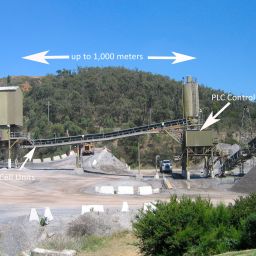
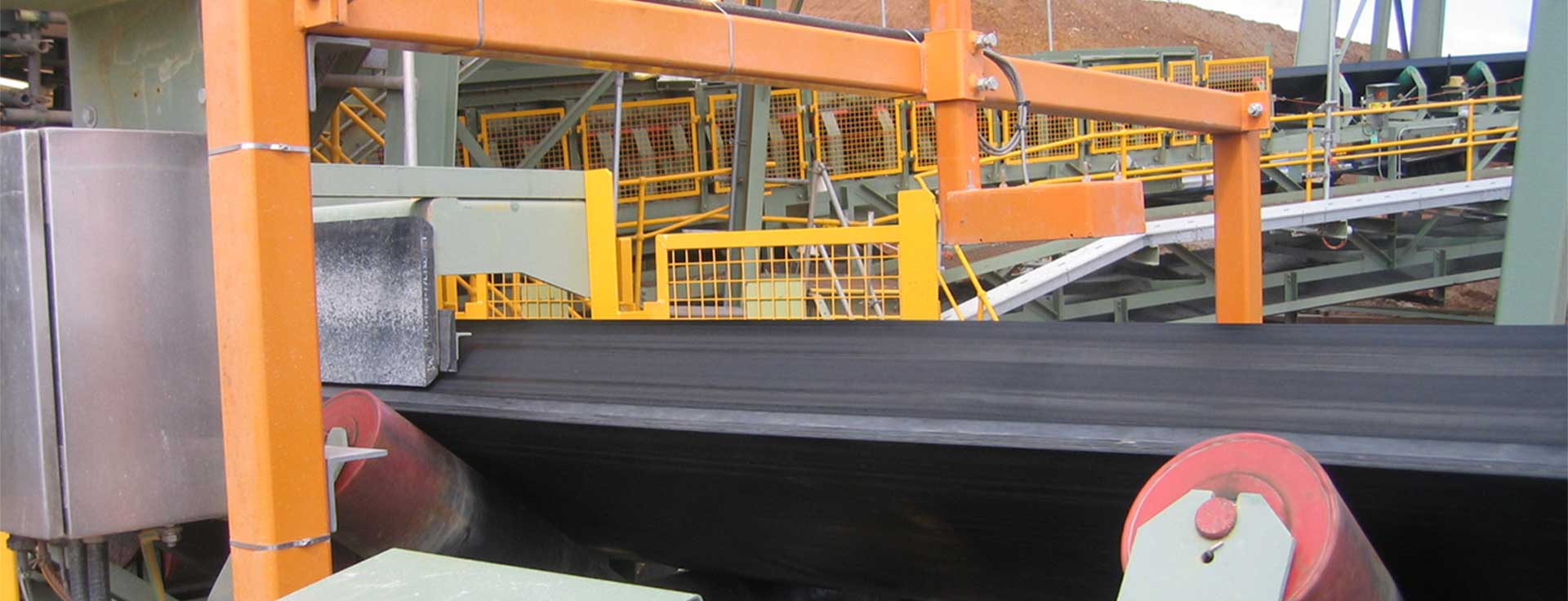
hydroSCAN is supplied with a rugged Support Frame which allows easy, accurate alignment the microwave transmitter and receiver housings on site. The system is also supplied with an electrical enclosure which houses the PLC which is used for data processing.
Find out more about the system here.
Talk To One of Our Specialists
We are striving to be the leading supplier of on-line process measurement technologies and are keen to offer you: