AUSTRALIAN IRON ORE
A Great Success Story (Part 1, December 2025)
Have Exports Peaked? (Part 2, January 2026)
Australia supplies a little over 50% of the world’s iron-ore exports (by value). These have increased from almost nothing in the 1950s to our single-largest export commodity today.
Part 1 below considers what lies behind Australia’s success.
Part 2 (next month) considers the potential threat to Australia’s iron-ore exports from the expected economic slowdown in China in coming years and from the emergence of others as new (e.g. Guinea) or growing (e.g. Canada) iron-ore exporters.
The Pilbara region of Western Australia produces nearly all Australia’s iron ore (with small amounts coming from other parts of Western Australia, South Australia and Tasmania).
Rio Tinto and BHP, the pioneers of the industry in the Pilbara, are still the two main producers, accounting for over two-thirds of Australian iron-ore exports. Next comes Fortescue Metals Group (a little over 20% of exports), then Hancock Prospecting and Mineral Resources.
Some 99% of Australia’s iron ore is exported. Around 80% of exports go to China.
Australia has benefitted greatly from:
- the vast iron-ore resources in the Pilbara, the largest in the world
- their relatively high grade (reaching 65% iron in the past and now in the range of 55-63%)
- the dominance in Australia’s iron-ore resources of hematite, which can be shipped following crushing and screening (not requiring further processing as is the case with magnetite, which is important in Brazil, Australia’s main competitor)
- efficient production methods and an extensive rail network linking mines with ports
- low cost of shipping to China, compared to that of most competitors
Note: hematite = Fe2O3; magnetite = Fe3O4.
Australian iron-ore production, million tonnes, 1960 to 2024

Sources: Dr Allon Brent, Australia’s Bulk Commodity Giants, Minerals Council of Australia, 2021; Office of the Chief Economist, Canberra, Resources and Energy Quarterly.
There are two other specific reasons for Australia’s success.
The first relates to the typical size of iron-ore when mined. Most iron ore consists of so-called “fines” (less than 6-7 mm in size); the remainder (greater than 6-7 mm in size) is known as “lump”.
The steelmaking process starts by combining iron ore with metallurgical coal (in the form of coke) in a blast furnace, to produce iron metal.
Blast furnaces require iron ore that is 6-7 to 31 mms in size, that is, lump. Iron-ore that is less than 6-7 mms in size (fines) has to be agglomerated before being used in a blast furnace. Because agglomeration is an additional cost step, lump iron-ore is favoured by steel manufacturers.
Australian iron ore contains a high proportion of lump, reaching 30-40% in many deposits – “a key comparative advantage which Australia enjoys over competitors” (Dr Allon Brent).
The second relates to the issue of impurities.
Iron metal from a blast furnace is further treated, notably by reducing carbon, to produce steel. Alloying elements – such as chromium, nickel, manganese, molybdenum, silicon, boron and tungsten – are typically added to steel to improve properties such as strength, hardness, toughness, and corrosion resistance.
Iron ore usually contains impurities – notably alumina, silica and phosphorous – that may need to be reduced for the effective production of iron and steel.
Australian iron ore is typically reasonably low in alumina and silica.
Adding to our good fortune, Pilbara iron-ore production began in the 1960s from deposits that were low in phosphorus, as well as being high in lump ore (initially, these were Mt Goldsworthy east of Port Hedland, Mt Whaleback near Newman and Mt Tom Price near Tom Price).
Such deposits “were the mainstay of Pilbara production throughout the 1970s, 1980s and into the 1990s” (Dr Allon Brent).
At the same time, many Pilbara deposits are high in phosphorus. However, the development in the 1990s of technology enabling steel mills to reduce phosphorous “has been the key to unlocking the development of the vast high-phosphorus Pilbara resources, previously considered unsaleable”.
In short, Australia has benefitted from these characteristics of Pilbara iron ore: relatively high levels of lump and low levels of alumina and silica, with high phosphorus levels not proving a major problem.
(The quotations by Dr Allon Brent are from Australia’s Bulk Commodity Giants, Minerals Council of Australia, 2021.)
Australia’s annual exports are expected to grow marginally (perhaps to 1 billion tonnes) over the next two years. Will they then decline because of a slowdown in China’s economic growth and the emergence of other countries weakening Australia’s export dominance? These issues are explored next month.
Map of iron-ore mines and railways in the Pilbara region (source: Calistemon)

Don’t miss an issue!
To stay connected and up to date with news within the mining industry, subscribe to the Mining Monitor. We’ll email a copy through to you at the beginning of each month.
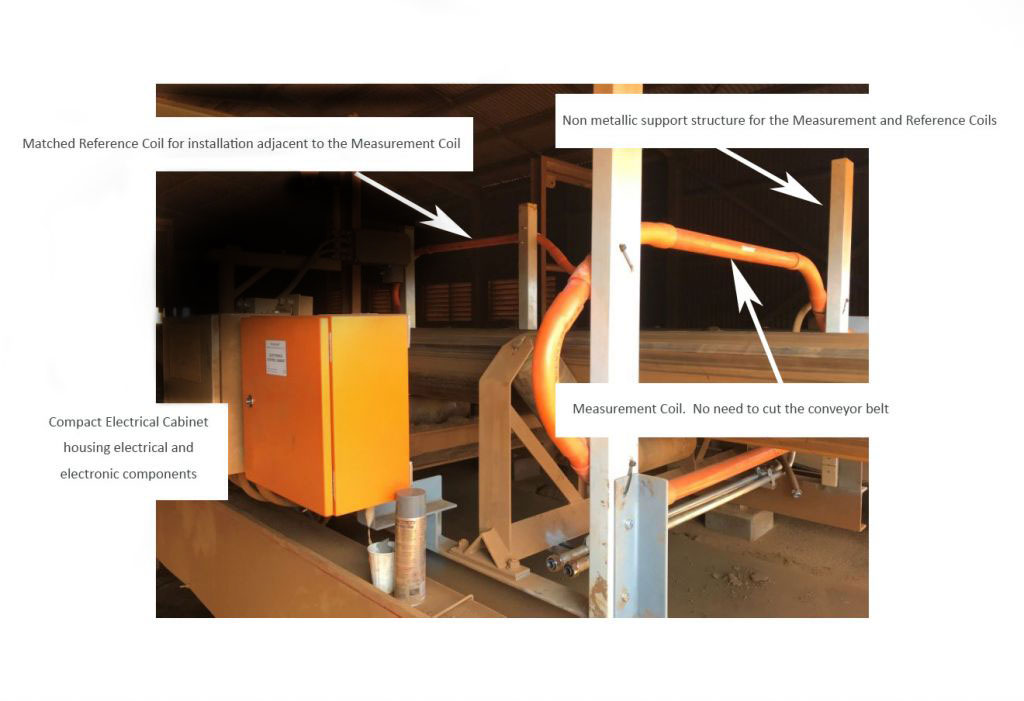
ironSCAN On Conveyor Magnetite Monitor
IRONSCAN ON CONVEYOR MAGNETITE MONITOR
The system has been designed for installation on tonnage rated conveyor belts for the measurement of the metaliferrous content of crushed ore prior to processing.
Find out more about the system here.
Talk To One of Our Specialists
We are striving to be the leading supplier of on-line process measurement technologies and are keen to offer you: